Scientists Discover That Exercise May Train the Brain More Than Muscles
Your Brain Is Training Too: The Hidden Neural Effect of Exercise
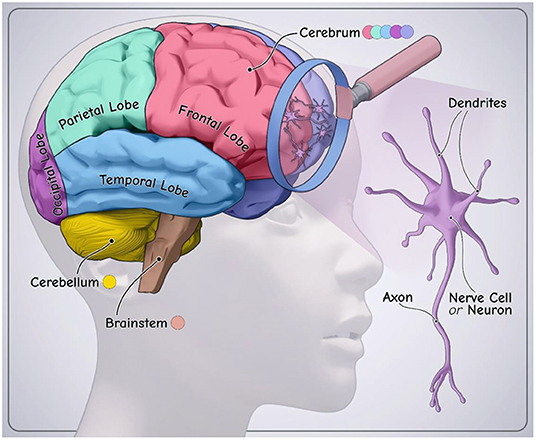


Most people think exercise is all about muscles. Stronger legs. Better lungs. A healthier heart.
But something far more interesting might be happening behind the scenes.
Recent research published in the journal Neuron from Cell Press suggests that endurance training may actually begin in the brain. Not the muscles. Not the heart. The brain.
When I first read this, I had to pause for a moment. We usually picture endurance as a purely physical ability. But according to this study, part of your ability to run longer or train harder may come from neural circuits quietly adapting after the workout is over.
And that idea completely changes how we think about exercise.
Your Endurance Might Start in a Tiny Brain Circuit
Scientists led by J. Nicholas Betley at the University of Pennsylvania wanted to understand something many people casually mention after a workout: mental clarity.
People often say they feel sharper after exercising. Clearer. More focused.
Instead of dismissing that feeling as psychological, the researchers decided to look directly at the brain.
To do that, they studied mice running on treadmills while tracking neural activity in real time.
What they discovered was surprisingly specific.
A region of the brain called the ventromedial hypothalamus (VMH) lit up during exercise. This area already has a reputation in neuroscience—it helps regulate how the body manages energy, body weight, and blood sugar levels.
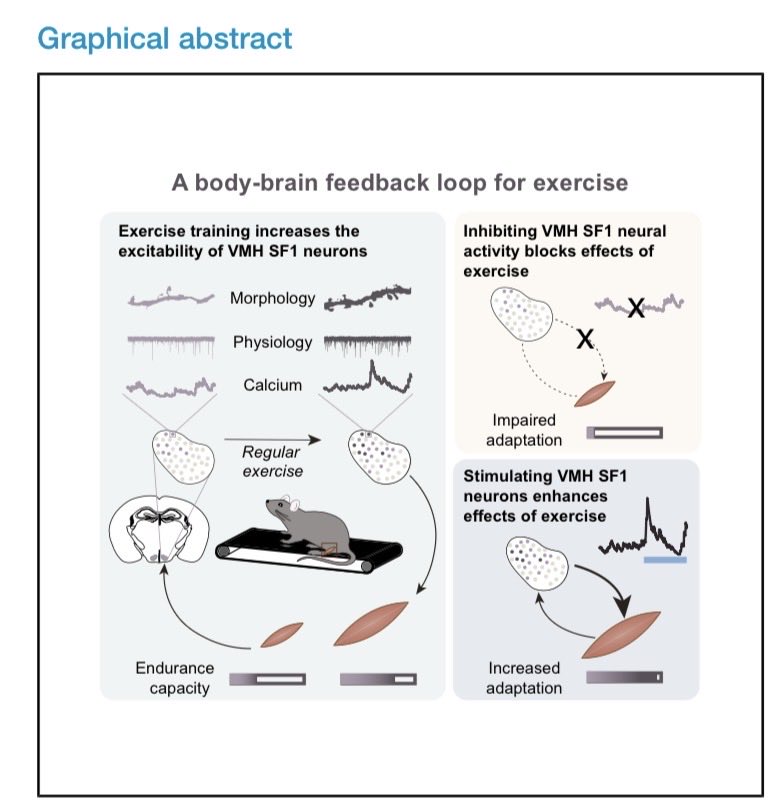
But what really caught the researchers’ attention were particular neurons inside this region called steroidogenic factor-1 neurons, or SF1 neurons.
These neurons didn’t just activate while the animals were running.
They stayed active long after the exercise stopped.
For at least an hour.
The Brain Keeps Working Long After the Workout Ends


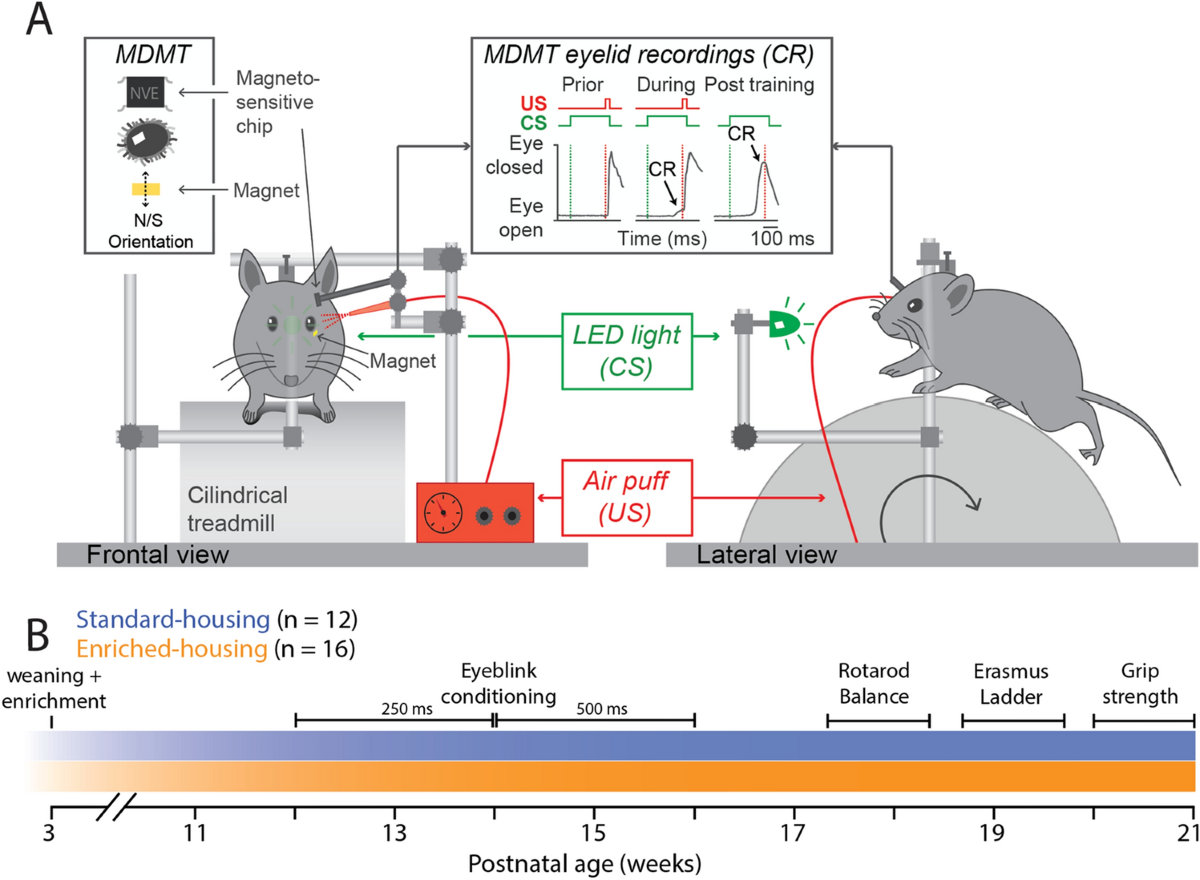
That detail might sound small, but it’s actually the key discovery of the study.
The brain didn’t shut off when the running stopped. Instead, those SF1 neurons remained active, as if continuing to process the experience.
When the mice trained every day for two weeks, something interesting happened.
Their endurance improved dramatically. They could run farther. Faster. And they took longer to fatigue.
At the same time, researchers saw a clear neural change.
More SF1 neurons were activating after each workout, and the strength of their activity increased compared with the beginning of the training period.
I find this fascinating because it suggests endurance isn’t just built during the workout itself. Part of the adaptation might happen afterward, when the body is supposedly “resting.”
The brain may be consolidating the training effect.
What Happens If Those Brain Neurons Are Switched Off?
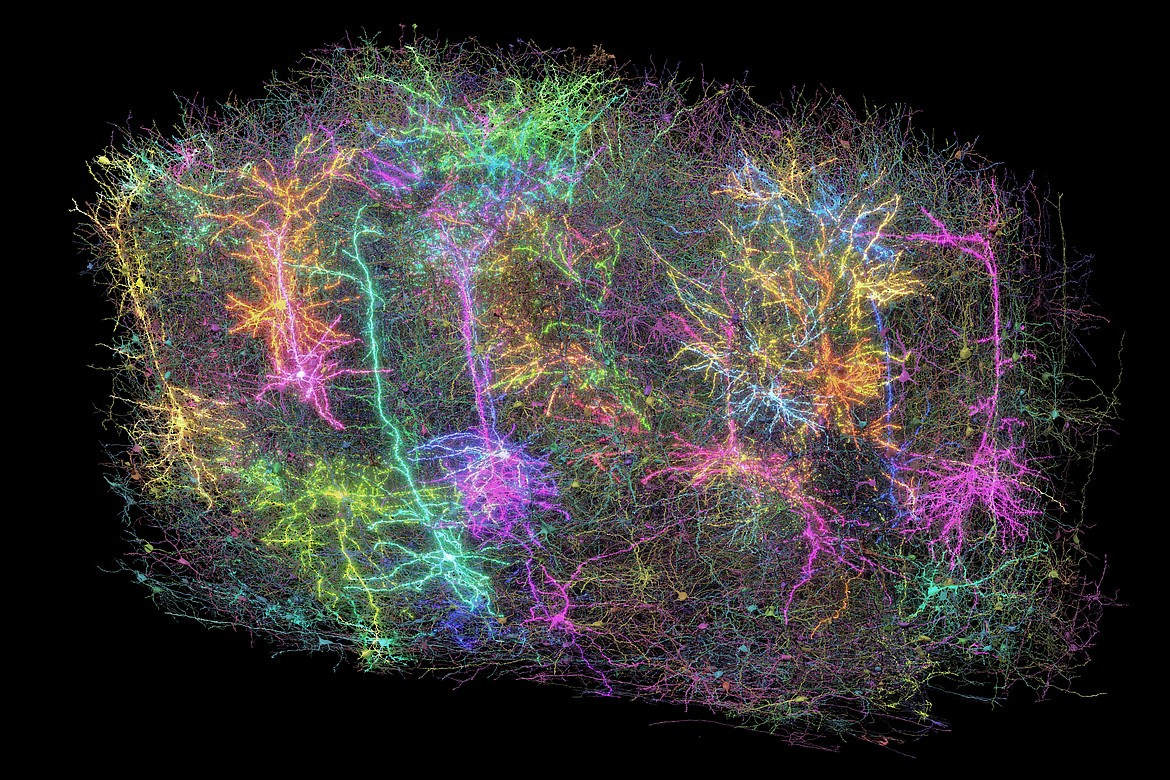
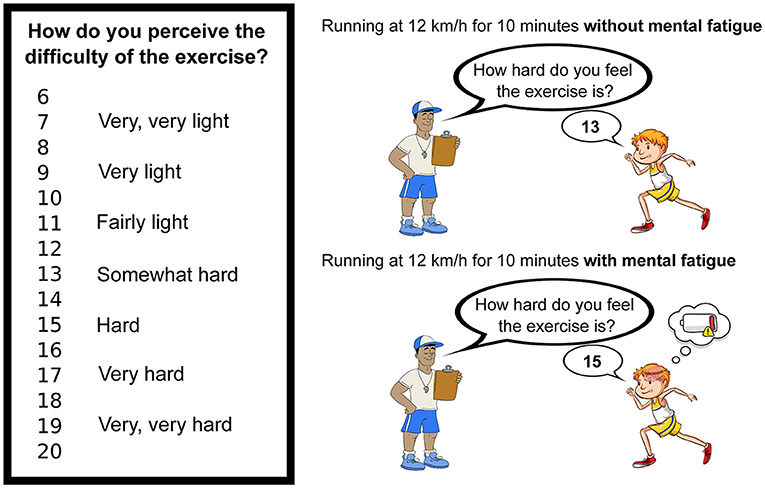
To test whether those neurons were actually responsible for endurance improvements, the researchers did something clever.
They blocked the SF1 neurons so they couldn’t communicate with the rest of the brain.
The result was immediate.
The mice tired quickly and failed to build endurance during the two-week training period.
But here’s the part that honestly surprised me the most.
When scientists allowed the neurons to function normally during the workout, but then shut them down after the workout, the endurance improvements still disappeared.
In other words, the brain activity that happens after exercise seems to be just as important as the exercise itself.
That’s the part most science articles skip over. Adaptation may occur during recovery, when the brain is still processing the event.
Exercise May Be Rewiring the Body’s Energy System

Researchers are still figuring out exactly how these neurons influence endurance.
One leading idea involves energy regulation.
The ventromedial hypothalamus helps control how the body stores and uses glucose, the primary fuel for muscles during exercise.
Betley suggests that when SF1 neurons stay active after a workout, they may improve how the body manages that stored energy.
Better energy management means muscles, lungs, and the heart could adapt more efficiently to repeated training.
Instead of just strengthening muscles, exercise may be tuning the entire metabolic system through neural signals.
Which, when you think about it, makes perfect evolutionary sense. The brain coordinates everything else in the body. Why wouldn’t it coordinate endurance too?
Why This Discovery Could Matter for Millions of People


Understanding these brain mechanisms could have important medical applications.
The research team believes this knowledge may eventually help:
Older adults maintain physical fitness
Stroke survivors regain mobility
People recovering from injuries rebuild endurance
Athletes optimize training programs
If scientists learn how to enhance or support these neural processes, the benefits of exercise might appear faster or become easier to achieve.
That could make a huge difference for people who struggle to stay active.
Betley puts it simply: exercise might not just build muscles.
It might also build the brain.
And personally, that’s the kind of discovery I love writing about here on Open Your Mind. Every so often science reminds us that the human body is far more interconnected than we imagined.
I’ll definitely be watching where this research goes next. If scientists can learn how to amplify these neural training signals, it could change how we design exercise, rehabilitation, and maybe even treatments for metabolic disease.
And if that happens, the idea of “training your brain” might take on a very literal meaning.
Infographics



Open Your Mind !!!
Source: Cell Press / Neuron Journal


Comments
Post a Comment