Light Squeezed Out of Darkness: An Accessible Guide to the Astonishing Quantum Simulation

Light Squeezed Out of Darkness: An Accessible Guide to the Astonishing Quantum Simulation
Around mid-2025, a team of physicists from the University of Oxford and the Instituto Superior Técnico in Lisbon achieved a breakthrough simulation demonstrating how real light can seemingly emerge from empty space. While it may sound like magic, this phenomenon is grounded in the deeply strange realm of quantum electrodynamics (QED), where even "nothing" has hidden potential.
Table of Contents
-
What does “light from darkness” mean?
-
How simulation makes the invisible visible
-
Understanding vacuum four-wave mixing
-
The simulation setup: lasers, OSIRIS, and quantum vacuum
-
🚀 Why this breakthrough matters
-
What comes next: real lasers and new physics
-
FAQs
-
Key takeaways
1. What Does “Light from Darkness” Mean?
In everyday life, we think empty space is just… empty. But quantum mechanics says there’s more going on:
-
Virtual particles — emergent pairs of electrons and positrons — constantly pop into and out of existence in the vacuum, per Heisenberg’s uncertainty principle.
-
Normally, these virtual particles annihilate each other too quickly to have noticeable effects.
-
However, if you apply extremely powerful electromagnetic fields, such as from trillions-of-watts laser pulses, these fluctuations can interact and produce real photons.
-
In such strong fields, photons can scatter off each other—a surprising behavior known as photon–photon scattering.
This isn’t science fiction—it’s a real prediction from QED, but one that has evaded direct experimental confirmation. These new simulations help us learn how to finally observe it.
2. How Simulation Makes the Invisible Visible
Capturing vacuum effects in real life requires lasers powerful enough to detect tiny quantum fluctuations. That’s where simulations come in:
-
OSIRIS, a powerful simulation code, was used in an advanced version that supports real-time, 3D modeling of quantum vacuum dynamics (sciencedaily.com, scienceblog.com).
-
This computational model tracked how three intense, focused laser pulses interact in a small volume of vacuum.
-
The simulation treated the vacuum semi-classically—calculating electromagnetic field evolution and how virtual particles polarize and scatter photons.
-
The result? For the first time, researchers captured full quantum signatures of light emerging from empty space (independent.co.uk, physics.ox.ac.uk).
Imagine watching a computer-generated experiment where three laser beams overlap, and boom—a fourth beam of light appears, moving in a different direction and with a unique color.
3. Vacuum Four-Wave Mixing Explained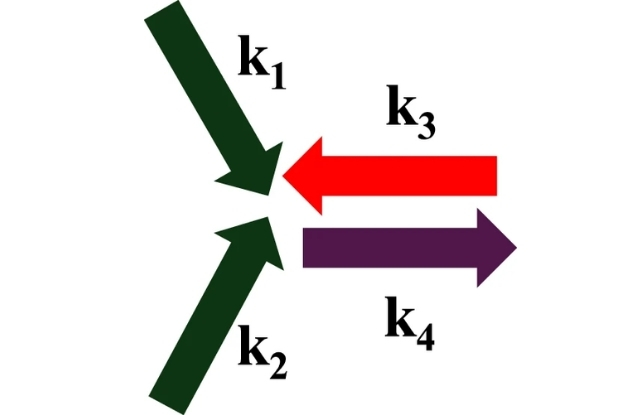
This process at the heart of the breakthrough goes by a technical name:
Vacuum Four-Wave Mixing (VFWFM)
Here’s how it works in simple terms:
-
Two intense laser pulses (Pump A and Pump B) and one probe pulse overlap in empty space.
-
These pulses establish a strong, inhomogeneous electromagnetic field in the vacuum.
-
The field temporarily polarizes virtual electron–positron pairs in the vacuum.
-
These pairs induce nonlinear interactions among photons—making them scatter off each other like billiard balls.
-
One photon enters a new state, creating a fourth beam with a different wavelength/direction that conserves energy and momentum.
While this type of four-wave mixing is common in nonlinear optics involving matter, the novelty here is seeing it in bare vacuum, involving virtual particles from the QED field (sciencedaily.com).
4. The Simulation Setup: Lasers, OSIRIS, and Quantum Vacuum
Understanding how the simulation was done gives deeper insight:
-
Three laser beams: Two green petawatt-class beams and one red beam overlap at a focal point to maximize field strength (independent.co.uk, sciencedaily.com).
-
Vacuum as a medium: The simulation assumes no real particles—just electromagnetic fields and virtual particle contributions.
-
Photon logging: The software logs the photon's behavior—where and when the fourth beam forms.
-
Time resolution: OSIRIS captures events in femtoseconds (10⁻¹⁵ s), crucial for detecting quantum interactions.
Results highlighted:
-
Astigmatism of the fourth beam—an elliptical shape due to beam overlap geometry (scienceblog.com, independent.co.uk).
-
Precise timing: The output pulse appears and propagates about 99% the speed of light after field overlap dissipates (scienceblog.com).
-
Harmonic generation: Besides the primary beam, weaker high-frequency pulses appear, some short-lived, depending on pulse timings (scienceblog.com).
These details are essential for designing real-world experiments that can distinguish this quantum effect from noise.
5. 🚀 Why This Breakthrough Matters
-
Bridges theory and experiment: QED predicted this decades ago, but clean, real-time 3D predictions were missing.
-
Blueprint for future tests: Laser facilities can now use realistic beam profiles, positions, and pulse timings.
-
Detecting exotic physics: These simulation tools can model how undiscovered particles (like axions) affect photon interactions (scienceblog.com, physics.ox.ac.uk).
-
Supports next-gen lasers: Facilities planned or coming online—like ELI (Romania), Vulcan 20–20 (UK), SEL and SHINE (China), OPAL (USA)—are in a position to observe vacuum scattering (physics.ox.ac.uk).
As Professor Peter Norreys noted, the discovery is not just academic—it’s a "major step toward experimental confirmation of quantum effects that until now have been mostly theoretical" (sciencedaily.com).
6. What Comes Next: Real Lasers and New Physics
Global Laser Efforts Underway
-
Vulcan 20–20 (UK): A next-generation petawatt laser.
-
Extreme Light Infrastructure (ELI, Romania): Already achieving 10 PW, growing rapidly (scienceblog.com, sciencealert.com).
-
OPAL 25 PW facility (University of Rochester, USA): Photon–photon scattering is a flagship experiment (physics.ox.ac.uk).
-
SEL and SHINE (China): Rapidly pushing toward 100 PW (zmescience.com).
What Comes Next
-
Experimental validation: The next step is performing this test in labs using actual lasers to confirm light scattering in vacuum.
-
Quantum dark-matter hunts: Simulations are extendable to investigate axions or millicharged particles, potentially uncovering new physics (physics.ox.ac.uk).
-
New simulation extensions: OSIRIS simulations will evolve to model more complex beams like vortex or flying-focus pulses (physics.ox.ac.uk).
7. FAQs
Q: Has light ever been created from “nothing” before?
A: Conceptually yes, but never observed. This is the first detailed simulation of vacuum four-wave mixing in 3D, helping scientists plan the first real experiments.
Q: Why do we need super strong lasers?
A: Weaker fields can’t disturb virtual particles enough. Only petawatt-class lasers can produce electromagnetic fields intense enough to polarize the quantum vacuum.
Q: How does the fourth beam escape background noise?
A: The beam has a unique direction, timing, and color. This makes it distinguishable from signals and helps separate it from other fluctuations.
Q: Could this reveal new particles like dark matter?
A: Yes. Certain hypothetical particles slightly change how photons scatter. Comparing detailed predictions and measurements could help identify or constrain them.
8. Key Takeaways
-
Quantum vacuum is not empty—it teems with activity and virtual particles.
-
Vacuum four-wave mixing is a QED prediction where photons can scatter, creating a new beam.
-
Real-time 3D simulations reveal this process for the first time with full spatial resolution.
-
This work provides a roadmap for upcoming laser labs worldwide.
-
Discovering and studying this effect may unveil new physics, including early signs of dark matter particles.
In summary, what was once purely theoretical is moving toward experimental reality. Science stands at the threshold of truly seeing “light from darkness”—and with it, potentially unlocking deeper layers of the universe.


Comments
Post a Comment